

| Host: | Michael Barnett |
|---|---|
| Guests: | Brant Berglin and Robert Wresch |
| Quarter: | Growing in a Relationship with God |
| Lesson: | 1 |
| Sabbath: | April 4th, 2026 |
The Bible tells us that our world is infected with evil. Where did evil come from? Why did sin arise in the first place, and why has it continued to exist for so long?
Matt. 13:24-27 Here is another story Jesus told: “The Kingdom of Heaven is like a farmer who planted good seed in his field. 25 But that night as the workers slept, his enemy came and planted weeds among the wheat, then slipped away. 26 When the crop began to grow and produce grain, the weeds also grew. 27 “The farmer’s workers went to him and said, ‘Sir, the field where you planted that good seed is full of weeds! Where did they come from?’
Matt. 13:28 “‘An enemy has done this!’ the farmer exclaimed.
Matt. 13:36-39 “Then, leaving the crowds outside, Jesus went into the house. His disciples said, “Please explain to us the story of the weeds in the field. 37 Jesus replied, “The Son of Man is the farmer who plants the good seed. 38 The field is the world, and the good seed represents the people of the Kingdom. The weeds are the people who belong to the evil one. 39 The enemy who planted the weeds among the wheat is the devil. The harvest is the end of the world, and the harvesters are the angels.”
In this parable Jesus said that He was the farmer who planted the good seed. Note Jesus planted only good seed! The enemy who planted the weeds among the good seed is the devil, Jesus said.
So according to Jesus the reason why there is evil here on planet earth is because the devil planted evil on/in our world. How can we be sure that Jesus is not responsible for evil’s existence or its lingering on? And what is the nature of evil?
The Bible addresses these questions via many avenues. When I began studying this I saw only three or four paths down which to travel, but now I have found so many I can hardly fit them on a page.
Below is a Word smart art depiction of what I now see. The various categories link together and support the infinite goodness of God. You may wish to print the smart art below so you can better follow as I attempt to unpack what I have discovered so far.
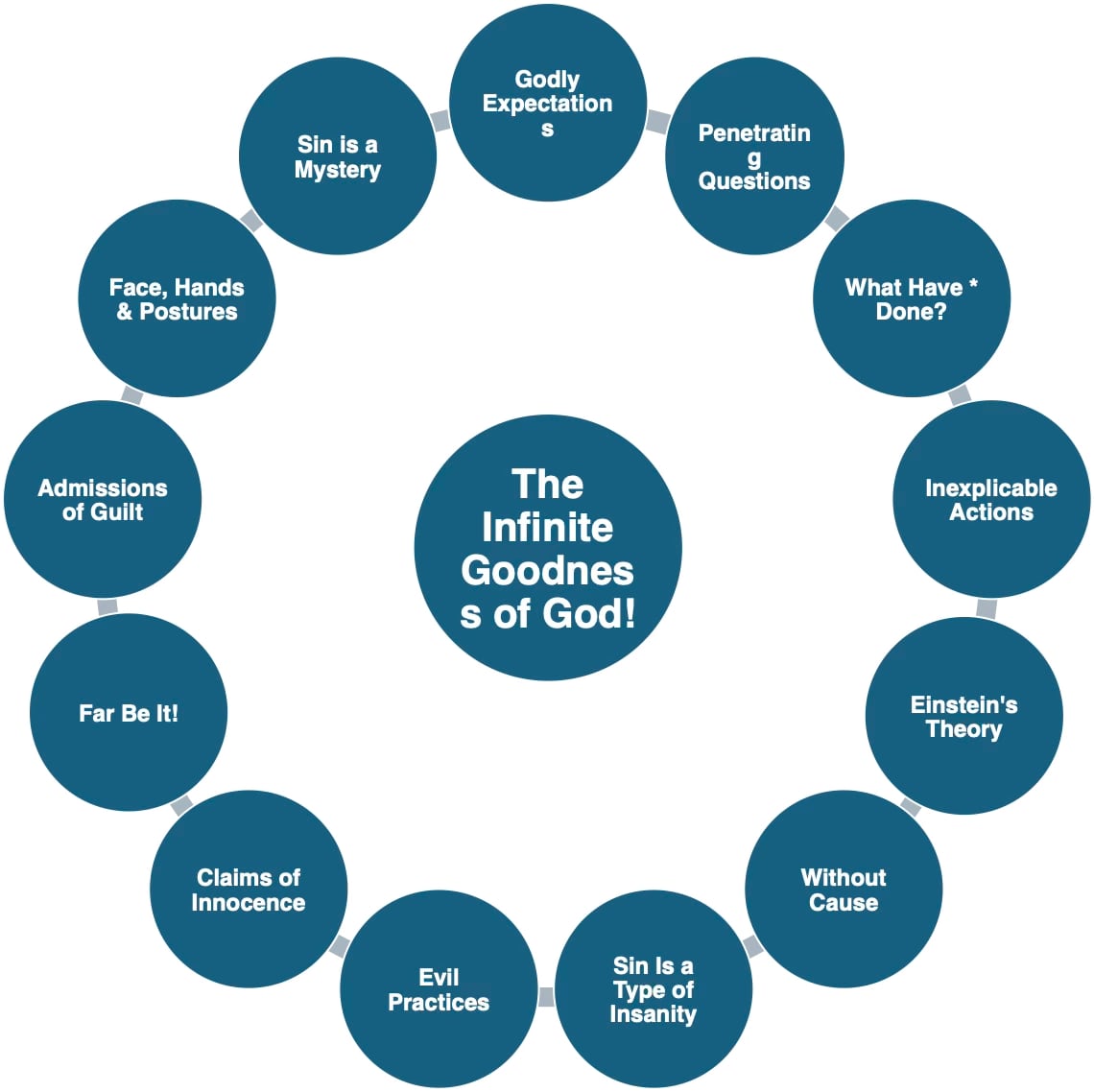
Why do you and I need a Savior? Firstly, because sin would have killed the entire human race the moment we humans first embraced it. But God in His mercy intervened and kept us alive. Secondly, if allowed to operate for a longer period of time, we need a Savior because sin damages our whole selves and God alone can fix us. Scripture tells us:
Ephesians 4:22-24 You were taught to put away your former way of life, your old self, corrupt and deluded by its lusts, 23 and to be renewed in the spirit of your minds, 24 and to clothe yourselves with the new self, created according to the likeness of God in true righteousness and holiness.
We ruin and deceive ourselves by our own lusts/desires, in other words, sin both ruins us and deceives us that it is ruining us. If we are to be fixed, to be healed, we must be re-created by God, born again, John tells us in his gospel. So the Apostle Paul wrote that we must put away our old selves and be re-created by God so we can be the kind of people God originally created us to be. Why do we need God to do this for us?
Ecclesiastes 8:8 No one has power over the wind to restrain the wind, or power over the day of death; there is no discharge from the battle, nor does wickedness deliver those who practice it.
Sin has no power within itself to fix us, to care for the wounds it inflicts, to heal us from sin itself, nor does it have a desire to fix us! Therefore, we need someone outside of our sin-infected selves to save us from sin. We need to be re-created according to the likeness of God in true righteousness and holiness. God is the only one able to do this and thank God He is also willing to save us from sin! God is both willing and able to help us, to cure us of our sin-damaged condition.
Faith, that is, our trust in God, is the means God uses to re-create us in His image. But true faith is earned, never blind. God must prove Himself trustworthy and that means He must show that He is not in any way responsible for the rise and development of evil.
But how might we come to know that God is not in any way responsible for sin’s existence or continuance? The categories in the blue smart art above offer us a variety of paths wherein God’s infinite goodness is established. Let’s start with the top category and move clockwise around the circle. You might want to print page 2 of this document and use it follow the discussion below.
Godly Expectations
Godly expectations surface in both the OT and the NT. For example: In this first passage below the Lord’s expectations were that his choice vines (Israel) would produce sweet grapes but they did not!
Isaiah 5:1-4 Let me sing for my beloved my love-song concerning his vineyard: My beloved had a vineyard on a very fertile hill. 2 He dug it and cleared it of stones, and planted it with choice vines; he built a watchtower in the midst of it, and hewed out a wine vat in it; he expected it to yield grapes, but it yielded wild grapes. 3 And now, inhabitants of Jerusalem and people of Judah, judge between me and my vineyard. 4 What more was there to do for my vineyard that I have not done in it? When I expected it to yield grapes, why did it yield wild grapes?
With the words: “what more was there to do” God stated unequivocally that He had done everything He could do so that His vines could and would produce good fruit. This is a key idea because it tells us that God is not responsible for evil, whether in the world generally or seen in the life of His followers. God’s actions, that He had lovingly done all that could be done, make even God question why then did His choice vines produce sour grapes? For which question even God provided no answer!
With: “When I expected…why did it” God expressed both His expectation (sweet grapes), given all that He had done, and His utter bewilderment at the results! Again, even God cannot tell us why people sin!
In the passage below God’s expectations were that His people would not deal falsely, that is, treasonously betray Him, but instead they did! Again, given all that God had done for His people, why did they rebel against Him and grieve the Holy Spirit?
Isaiah 63:8-10 For he said, “Surely they are my people, children who will not deal falsely”; and he became their savior 9 in all their distress. It was no messenger or angel but his presence that saved them; in his love and in his pity he redeemed them; he lifted them up and carried them all the days of old. 10 But they rebelled and grieved his Holy Spirit….
Thirdly, Jesus told a parable wherein the owner of the vineyard (representing God the Father) sent numerous agents (prophets) to a group of renters, which the renters treated badly; finally, the owner expressed his sure expectation that his renters would respect his last agent, his own son (Jesus), but they did not!
Mark 12:5-7 Then he sent another, and that one they killed. And so it was with many others; some they beat, and others they killed. 6 He had still one other, a beloved son. Finally he sent him to them, saying, ‘Surely, they will respect my son.’ 7 But those tenants said to one another, ‘This is the heir; come, let us kill him, and the inheritance will be ours.’
Many readers seem to want to mask or even remove these godly expectations because they cannot see how they mesh with God’s foreknowledge, but these divine expectations help reveal God’s infinite goodness, and therefore the innocence of God regarding evil. God is neither the cause of evil nor is He the reason it has continued as it has.
If God were to expect a poor outcome as a response to His love would we not wonder whether God Himself was somehow at fault?
So again, these godly expectations help establish the utter goodness, and therefore the complete innocence, of God regarding the rise and development of evil.
Penetrating Questions
The second category is that of “Penetrating Questions.” These questions drill down into the heart of the matter regarding the existence and development of evil.
God’s Penetrating Questions:
“Why are you so angry? The LORD asked Cain. “Why do you look so unhappy?” Genesis 4:6.
Notice that these two questions ask why? Why is Cain angry and unhappy? Again, God is in some sense genuinely puzzled. By these questions God is implying that nothing He has done led (or even could or should have led) Cain to become, let alone stay, angry and unhappy. Notice also that Cain offered no answers to God’s questions. Why not? Because there were none to give! In the following five passages no response is given to God’s heart-broken enquires, spoken by God or by His prophets.
Isaiah 50:2 Why was no one there when I came? Why did no one answer when I called? Is my hand shortened, that it cannot redeem? Or have I no power to deliver? By my rebuke I dry up the sea, I make the rivers a desert; their fish stink for lack of water, and die of thirst.
Isaiah 55:2 Why do you spend your money for that which is not bread, and your labor for that which does not satisfy? Listen carefully to me, and eat what is good, and delight yourselves in rich food.
Jeremiah 2:5 Thus says the LORD: What wrong did your ancestors find in me that they went far from me, and went after worthless things, and became worthless themselves?
Jeremiah 2:31 And you, O generation, behold the word of the LORD! Have I been a wilderness to Israel, or a land of thick darkness? Why then do my people say, “We are free, we will come to you no more”?
Malachi. 2:10 Are we not all children of the same Father? Are we not all created by the same God? Then why do we betray each other, violating the covenant of our ancestors?
No one rose up to answer God’s questions, like Cain all were silent! Why? Sin is not defensible, not because God is unwilling to listen to human responses, but because sin is unreasonable, illogical, inexcusable, and therefore impossible to explain or defend.
God’s People Also Asked Penetrating Questions:
1Samuel 20:32-33 Then Jonathan answered his father Saul, “Why should he [David] be put to death? What has he done?” 33 But Saul threw his spear at him to strike him; so Jonathan knew that it was the decision of his father to put David to death.
King Saul’s answer to his own son’s penetrating question was to hurl a spear at him! Saul engaged in a violent act, but no valid answer was offered. Why not? Because, as Jonathan said elsewhere, David had put his own life on the line and battled Goliath, thus rescuing the nation from being conquered by the Philistines. In other words, given all the good that David had done for King Saul and God’s people, it made no sense for Saul to desire David’s death. So when asked why David should die, Saul‘s only answer was to throw a spear!
When Paul confronted Peter regarding Peter’s own (mis)conduct, there is no response recorded. (Have you ever noticed how guilty people often respond with silence?)
Galatians 2:11-14 But when Cephas came to Antioch, I opposed him to his face, because he stood self-condemned; 12 for until certain people came from James, he used to eat with the Gentiles. But after they came, he drew back and kept himself separate for fear of the circumcision faction. 13 And the other Jews joined him in this hypocrisy, so that even Barnabas was led astray by their hypocrisy. 14 But when I saw that they were not acting consistently with the truth of the gospel, I said to Cephas before them all, “If you, though a Jew, live like a Gentile and not like a Jew, how can you compel the Gentiles to live like Jews?”
Jesus Also Asked Penetrating Questions:
Matt. 14:31 Jesus immediately reached out his hand and caught him [Peter], saying to him, “You of little faith, why did you doubt?”
Peter had asked if he could also walk on the water, just as Jesus Himself was doing. But after walking on it for a bit Peter began to doubt. Once again, there is no recorded answer to a penetrating question. Think–what would Peter have said to justify his doubt of Jesus? Had Peter not seen Jesus Himself walking on the water and performing other miracles?
In the next three biblical passages note how the responses to questions asked were that of silence.
Matt. 22:11-12 “But when the king came in to see the guests, he noticed a man there who was not wearing a wedding robe, 12 and he said to him, ‘Friend, how did you get in here without a wedding robe?’ And he was speechless.
Mark 3:4 Then he said to them, “Is it lawful to do good or to do harm on the Sabbath, to save life or to kill?” But they were silent.
Mark 9:33-34 Then they came to Capernaum; and when he was in the house he asked them, “What were you arguing about on the way?” 34 But they were silent, for on the way they had argued with one another who was the greatest.
When the king had already provided a wedding garment for each person attending there was obviously no reason why one couldn’t/shouldn’t wear it. Yes, according to Scripture it is lawful to do good on the Sabbath. And selfishness and hubris are never defensible!
In Mark 3:4 above when Jesus healed a man with a withered arm and asked His detractors: Is it lawful to do good or to do harm, we go on to read in Mark 3:6 that
“the Pharisees went out and immediately conspired with the Herodians against Jesus, how to destroy him.”
Like King Saul’s reaction toward his son Jonathan, the Pharisees had no answer for the question they were asked so they reacted with violence. Silence and violence were often the responses to penetrating questions regarding the evil existing in one’s own heart and mind.
The silence and violence of sinners testifies to the innocence of God in causing evil to exist or continue. Now there are other responses to the penetrating questions regarding evil portrayed in Scripture, but silence and violence are very common responses, then, and even now.
Regarding sins of omission: when we don’t do the right thing, what can we say in our defense?
Regarding sins of commission: when we do the wrong thing, how can we justify our actions?
What Have * Done?
When studying this topic of Penetrating Questions there is one question that is so often used in Scripture that I’ve given it its own category, which I’ve universalized with an asterisk because this question shows up in varying forms, like: What is this that you have done? What have I done? What have they done? [Therefore, What have * done?]
This question is often used to draw a sharp contrast between those who are innocent and those who are guilty of doing some wrong. But that’s not all. The question also expresses a powerful form of shock and puzzlement! “Why would X have done this to me! I did nothing to deserve such treatment.” Here are some examples:
Genesis 3:13
Then the LORD God said to the woman, “What is this that you have done?” The woman said, “The serpent tricked me, and I ate.”
Genesis 4:10
And the LORD said [to Cain], “What have you done? Listen; your brother’s blood is crying out to me from the ground!
Genesis 12:18
So Pharaoh called Abram, and said, “What is this you have done to me? Why did you not tell me that she was your wife?
Genesis 20:9
Then Abimelech called Abraham, and said to him, “What have you done to us? How have I sinned against you, that you have brought such great guilt on me and my kingdom? You have done things to me that ought not to be done.”
Genesis 26:10
Abimelech said, “What is this you have done to us? One of the people might easily have lain with your wife, and you would have brought guilt upon us.”
Genesis 29:25
When morning came, it was Leah! And Jacob said to Laban, “What is this you have done to me? Did I not serve with you for Rachel? Why then have you deceived me?”
Numbers 22:28
Then the LORD opened the mouth of the donkey, and it said to Balaam, “What have I done to you, that you have struck me these three times?”
Micah 6:3
“O my people, what have I done to you? In what have I wearied you? Answer me!
In Sum, Penetrating Questions and their varied responses, and the question: What Have * Done? are often used to establish one’s goodness, and therefore one’s innocence regarding evil. In this regard, note Micah 6:3 above where God asked this question. Because God has loved His people with an unfailing love, evidenced by all the good things He has done for them (see Micah 6:4-5), He is genuinely puzzled as to why they have responded to His love with treasonous rebellion instead (see Micah 6:7).
Inexplicable Actions
So far we’ve tackled the categories of Godly Expectations, Penetrating Questions, What Have * Done?, all of which support the idea that innocence exists and that God is not responsible for the rise or development of evil.
Now we’re moving on to the next two categories: Inexplicable Actions and Einstein’s Theory. In these two categories we’re looking at actions people undertook that defy understanding. They are illogical, unreasonable, inexcusable, and are therefore unexplainable. Yes, the person or people chose to do X, but a choice to do something is not the same thing as a valid reason for doing X.
Acts 3:14 But you rejected the Holy and Righteous One and asked to have a murderer given to you, 15 and you killed the Author of life, whom God raised from the dead. To this we are witnesses.
Here is the most inexplicable act in human history! And it is painted out as such by the author of Acts. Why would anyone ask for a murderer to be released, let alone so they could kill the Author of life?
In Isaiah 44 we read of those who: plant a tree, chop it into pieces, burn some parts of it, make a god from one part of it, worship that wooden part, and even pray to it, asking it to rescue them. This is all portrayed with a sense of complete bewilderment! Surely idolatry qualifies as an inexplicable act, as an act of utter insanity! Why would someone think that a mere block of wood, which they have partially and easily destroyed to accomplish mundane tasks, is somehow a god who can rescue them?
But oddly, this category of inexplicable actions worsens, if that’s possible, for oftentimes a person or a group of people do the same inexplicable thing repeatedly!
Einstein’s Theory
Which brings us to Einstein’s Theory, not the one usually thought of, but this one: Insanity is doing the same thing while expecting (or hoping for) different results.
For example, in Genesis 12:10-20 Abram (Abraham) lied about his wife and said she was his sister. This did not work out well, but in Genesis 20 Abraham repeated this very same mistake!
What’s more, in Genesis 26:1-11 Abraham’s son Issac chose to repeat this same evil, with a similarly poor outcome. Why do, let alone repeat, actions that are clearly not beneficial to all? There are no valid reasons for doing as they did.
Judges 2:3 contains another What Have You Done question from God Himself. After His query, and for the remainder of the book of Judges, we read of a nasty cycle where God’s people abandon Him and serve other gods, fall into oppression, cry out to God, He rescues them, so they enjoy some years of peace, but they ultimately chose to abandon God again, and this cycle repeats ad nauseum.
First, why did they abandon God? Was He not good to them? Second, why abandon God repeatedly? Abandoning God is itself an inexplicable action, but doing so repeatedly is in a category of insanity all its own! Einstein’s Theory accurately describes and interprets the repeated making and serving of idols and pagan gods throughout Scripture. Such acts simply don’t work out well so why do them again and again?
Sin is completely unreasonable. One cannot excuse it or defend it. Simply put, it makes no sense! It is inexplicable. One can neither understand it nor explain it. As Einstein’s Theory directs us: To sin the same sin repeatedly while expecting different results is itself an indicator of insanity!
Sin is a Type of Insanity
So speaking of evil as a type of insanity, we read in Ecclesiastes 9:3 NASB 77:
The hearts of all are full of evil; madness is in their hearts while they live….
With such an assertion the author does not mean that madness is evil, as if those with mental health concerns are more evil than others, but rather Ecclesiastes is saying instead that evil itself is a type of madness!
This biblical truth, that evil is madness, prepares us for when we see Ellen White portray sin as a type of insanity, and to better “hear” her when she says that sin deranges the whole human organism.
All sin is selfishness. Satan’s first sin was selfishness. He sought to grasp power, to exalt self. A species of insanity led him to seek to supersede God. The infinite value of the sacrifice required for our redemption reveals the fact that sin is a tremendous evil. Through sin the whole human organism is deranged, the mind is perverted, the imagination corrupted. Sin has degraded the faculties of the soul. Temptations from without find an answering chord within the heart, and the feet turn imperceptibly toward evil. Ministry of Healing 451:2
The reason why no one, not even God, can explain why sin arose and why it lingers, is because sin is inexplicable; it is a type of insanity.
Evil Practices
Deceit, lust, etc., are all insane acts. There is no way to understand why we do the evil things we do, no matter what evil is within our focus. Take deception, for example, which Scripture defines as a fundamental characteristic of sin (see Hebrews 3:13).
Obadiah 3-4 Your proud heart has deceived you, you that live in the clefts of the rock, whose dwelling is in the heights. You say in your heart, “Who will bring me down to the ground?” 4 Though you soar aloft like the eagle, though your nest is set among the stars, from there I will bring you down, says the LORD.
Obadiah 7 All your allies have deceived you, they have driven you to the border; your confederates have prevailed against you; those who ate your bread have set a trap for you— there is no understanding of it.
One simply cannot fathom why any created beings would think themselves invincible. Nor can we understand why someone’s allies would attack them. But look more closely at the intriguing nature of self-deception. (I am indebted to Dan O. Via, Jr. for some of these thoughts and expressions.) But here are some further texts:
Galatians 6:3 “For if those who are nothing think they are something, they deceive themselves.”
1 Corinthians 3:18 “Do not deceive yourselves. If you think that you are wise in this age, you should become fools so that you may become wise.”
Clearly self-deception is a human problem. It is selfish love that prompts us to lie, not only to others but also to our own selves! The irrational step in self-deception is found in our attempt to draw a boundary between our inconsistent self-beliefs, so we can hide them from each other! What “causes” us to do this? A cause that is not a reason! A choice to do something is not the same as a reason for doing it. Which brings us to the next category in the smart art graphic on page 2, Without Cause.
Without Cause
This is an expression often used in Scripture to describe Inexplicable Actions, yes, even insane actions. Because it is found numerous times in Scripture I have given it its own category. The original Hebrew word is translated in different ways throughout Scripture; it is not uncommon for it to be rendered “for no reason.” At root it seems to mean “nothingness,” while the Greek of the NT below consists of two words, together meaning “no cause, no blameworthiness.”
1Samuel 19:5 for he [David] took his life in his hand when he attacked the Philistine, and the LORD brought about a great victory for all Israel. You saw it, and rejoiced; why then will you sin against an innocent person by killing David without cause?”
Acts 13:28 Even though they [the Jewish leaders] found no cause for a sentence of death, they asked Pilate to have him [Jesus] killed.
According to various biblical passages, sinners attack people who did not provoke them, they attack others without cause. In our sin-damaged world we too often think that people always deserve what others do to them. Both parties must be at fault. It takes two to tango, we often say. But Scripture teaches us that one party can be innocent, that he/she did nothing to provoke the one(s) who hurt them. The Bible teaches that incidences of unprovoked harm support the idea that God did nothing to warrant the response of sin! There is no weakness in: God’s character or the way in which He gently and wisely governs the universe or in His purposes for people. Sin is an action without a cause or a reason for doing it!
Claims of Innocence
The above 1Sam 19:5 passage juxtaposes the expression without cause with: Claims of Innocence. Jonathan said that David was innocent so why attack David without cause?
Regarding human innocence, we read:
Psalm 94:21 They band together against the life of the righteous, and condemn the innocent to death.
Jeremiah 37:18 Jeremiah also said to King Zedekiah, “What wrong have I done to you or your servants or this people, that you have put me in prison?”
Consider also the innocence of Jesus, of which we read:
Matthew 27:4 He [Judas] said, “I have sinned by betraying innocent blood.” But they said, “What is that to us? See to it yourself.”
Acts 13:28: Even though they [the Jewish leaders] found no cause for a sentence of death, they asked Pilate to have him [Jesus] killed.
Jesus set side-by-side His own innocence against the guilt of those who would later die, most likely in the destruction of Jerusalem in 70 AD.
Luke 23:31: “For if these things are done when the tree is green, what will happen when it is dry?”
Innocence is also supported by an explosive assertion:
Far Be It!
1Samuel 20:8-9 Therefore deal kindly with your servant, for you have brought your servant into a sacred covenant with you. But if there is guilt in me, kill me yourself; why should you bring me to your father?” 9 Jonathan said, “Far be it from you! If I knew that it was decided by my father that evil should come upon you, would I not tell you?”
The above passage attaches David’s question: “But if there is guilt in me” to Jonathan’s powerful response: “Far Be It!” together these expressions lay a claim to David’s innocence. The expression: Far Be It! Is often used to convey a powerful sense of innocence in the face of possible claims of guilt.
Listen to Abram’s claim regarding God:
Genesis 18:25 Far be it from you [God] to do such a thing, to slay the righteous with the wicked, so that the righteous fare as the wicked! Far be that from you! Shall not the Judge of all the earth do what is just?”
The explosive words: Far Be It! are often used to establish a claim of innocence, the innocence of various humans and even the innocence of God!
Admissions of Guilt
But we can also view God’s innocence via a reverse category: Admissions of Guilt, usually done by human beings, which we often label confessions.
Daniel 9:5-7 we have sinned and done wrong, acted wickedly and rebelled, turning aside from your commandments and ordinances. 6 We have not listened to your servants the prophets, who spoke in your name to our kings, our princes, and our ancestors, and to all the people of the land. 7 “Righteousness is on your side, O Lord, but open shame, as at this day, falls on us, the people of Judah, the inhabitants of Jerusalem, and all Israel, those who are near and those who are far away, in all the lands to which you have driven them, because of the treachery that they have committed against you.
Here God’s innocence is explicitly stated in sharp contrast to the guilt of His people.
Face & Postures
People in the Bible often expressed their belief in the innocence of God, in sharp contrast with their own guilt, by use of facial imagery and various postures. For example:
Ezra 9:6 REB ‘I am humiliated, my God,’ I said, ‘I am ashamed, my God, to lift my face to you. Our sins tower above us, and our guilt is so great that it reaches high heaven.
Ezra 9:15 REB Lord God of Israel, you are just; for we today are a remnant that has survived. In all our guilt we are here before you; because of it we can no longer stand in your presence.’
In Scripture, people hide their face from God and fall on their face before God, some with a deep sense of awe, but even those probably with some sense of their own sinfulness. Such desires, to hide one’s face from God, is a physical way of saying that God is innocent and we humans are the one in the wrong.
Because of their own guilt and sense of responsibility for wrongdoing people also say that they cannot stand before God, using physical imagery to state that God is innocent regarding the cause and continuance of evil.
Laying On of Hand(s)
The laying of one’s hands (or a hand) upon a sacrificial offering also physically indicated guilt and responsibility for evils done in sharp contrast with God’s unblemished innocence regarding evil.
Leviticus 4:4 He must bring the bull to the entrance of the Tent of Meeting before the Lord, lay his hand on its head, and slaughter it before the Lord.
Leviticus 16:21-22 Laying both his hands on its head he [the high priest] must confess over it all the iniquities of the Israelites and all their acts of rebellion, that is all their sins; he is to lay his hands on the head of the goat and send it away into the wilderness in the charge of a man who is waiting ready. 22 The goat will carry all their iniquities upon itself into some barren waste, where the man will release it, there in the wilderness.
The laying of one’s hand(s) on a sacrificial offering is another physical way of making clear one’s own or a group’s responsibility for the existence and continuance of sin, while declaring God to be innocent.
Sin Is Mysterious
Because sin has no cause, no reason for its existence or its development, sin is completely and eternally mysterious. Using the term “lawlessness” the Bible labels sin as a mystery, and nowhere in Scripture is this mystery explained.
2 Thessalonians 2:7 For the mystery of lawlessness is already at work.
Ellen White comments on the mystery of sin several times; here are some of her significant comments regarding the mysteriousness of sin:
In the day of final judgment, every lost soul will understand the nature of his own rejection of truth….In the judgment of the universe, God will stand clear of blame for the existence or continuance of evil. It will be demonstrated that the divine decrees are not accessory to sin. There was no defect in God’s government, no cause for disaffection. The Desire of Ages 58
Sin is an intruder, for whose presence no reason can be given. It is mysterious, unaccountable; to excuse it is to defend it. Could excuse for it be found, or cause be shown for its existence, it would cease to be sin. The Great Controversy 493
Sin appeared in a perfect universe….The reason of its inception or development was never explained and never can be, even at the last great day when the judgment shall sit and the books be opened….At that day it will be evident to all that there is not, and never was, any cause for sin. That I May Know Him 15
When we juxtapose the first Ellen White quote with the third, we see that in the final judgment God was stand clear of all blame for the existence or continuance of evil, while in that same judgment the reason for sin’s inception or development has never been explained, and never will be explained!
Summary
That God expected (and still expects!) positive responses to His great love teaches us that God is innocent regarding sin’s rise and its lingering on. There is no weakness in God that has inevitably led to the origin and development of sin.
By asking penetrating questions, including what have * done questions, innocence and guilt are established, and God is portrayed as innocent regarding evil.
Sinners engage in inexplicable actions, often the same actions repeatedly; actions against others can be engaged in without provocation, without cause, which leads us to believe that sin is a type of insanity. All evil practices (deceit, lust, etc.) are acts of insanity.
Claims of innocence are put forth in Scripture in various ways, including through the expression far be it, by admissions of guilt (confessions), use of facial and posture imagery, and the laying on of hands. Scripture refers to lawlessness as a mystery.
Benefits of: Believing That God Is Innocent! That Sin Has No Cause!
What are the benefits of believing that God is in no way responsible for the origin or development of evil? Of believing that God did not cause evil to arise nor has He in any way caused it to continue? At the very least four possibilities come to mind:
Firstly, that God is innocent, that there is no reason, no cause, for the existence or continuance of sin is itself a satisfying answer, when studied out! Anything less than God’s complete innocence would be an insurmountable barrier to faith in God.
Secondly, the certainty that sin is illogical, unreasonable, inexcusable, unjustifiable, foolish, and yes, downright insane, fosters a stronger desire to accept God’s love and break away from sin.
Thirdly, knowing that God has done, is doing, and will continue to do, everything He can to bring nothing but good to everyone fosters a strong love for God and a deeper trust in Him.
Fourthly, one of the strengths that we seek to gain from God’s own heart is the desire and ability to forgive others for the unjustifiable wrong that they have done to us. As C.S. Lewis wrote: “To be a Christian means to forgive the inexcusable in others because Christ has forgiven the inexcusable in us.”
Believing that God is innocent, that sin has no cause, will help us see more clearly, not only the true nature of sin, but also the true nature of forgiveness.
Questions:
Does the idea that sin is a type of insanity (perhaps now seen in a more systematic or comprehensive manner?) seem new to you? Why or why not? Are you persuaded by it? Why or why not? What might you add to the above arguments that support the idea that sin is a mystery because it simply is not rational?
Should this idea: that God is not responsible for the rise and development of evil be a separate doctrine of our church? Why or why not?
Would you agree that your own sinful actions are acts of insanity? If so, which of your sinful actions best illustrates this idea?
Why and how does Christ’s forgiving the inexcusable in you help you forgive the inexcusable in others?
Holiness
What is holiness? Has holiness always been an attractive notion to you? Or are you part of those who have often failed to see any beauty in traditional ideas of holiness? Are you satisfied with how the Bible itself presents holiness? Or do you wish for more? Or wish for better?
Certainly, Scripture highlights the holiness of God. For example:
Isaiah 6:3 And one called to another and said: “Holy, holy, holy is the LORD of hosts….”
Psalm 99:3, 5, 9 “Let them praise your great and awesome name. Holy is he!” 5 “Extol the LORD our God; worship at his footstool. Holy is he!” 9 “Extol the LORD our God…for the LORD our God is holy.”
Like Psalm 99:3 above, Isaiah 57:15 says of God: “whose name is holy.” In the Bible the word “name” occasionally refers to a label, but more often it refers to one’s reputation or character. This creates another window for studying the concept of holiness. For example:
Psalm 103:1-5 Bless the LORD, O my soul, and all that is within me, bless his holy name. 2 Bless the LORD, O my soul, and do not forget all his benefits—3 who forgives all your iniquity, who heals all your diseases, 4 who redeems your life from the Pit, who crowns you with steadfast love and mercy, 5 who satisfies you with good as long as you live so that your youth is renewed like the eagle’s.
Many ideas surface within this passage, but to bless the LORD’s holy name means to recognize and keep as a guiding principle in one’s life the reality that everything God does for others is beneficial to them. God’s name, that is God’s holiness, is portrayed by what God does, and all of what God does promotes flourishing: He forgives all our iniquity; heals all our diseases, redeems our life from the Pit; crowns us with steadfast love and mercy; satisfies us with good as long as we live, so that our lives are renewed!
This is why the Bible speaks about the “beauty of holiness,” see Psalm 29:2; 96:9; Isaiah 55:5.
Questions
Yet if the people presented in Scripture were called to be holy as God is holy (Leviticus 19:1), why are there so many deeply flawed people shown in the Bible’s stories?
What can you and I learn from the interactions of a holy God with sinners?
What can we learn from a holy God’s interactions with non-sinners (other members of the Trinity or angels who did not rebel against God)?
Attracted to God!
God does not bring us to Himself by condemning us! Or by coercing us! Scripture tells us that God draws us to Himself.
Jeremiah 31:3 Long ago the LORD appeared to me: “I have loved you with an everlasting love. Therefore, with unfailing love I have drawn you to myself.
Proverbs 16:6 NLT Unfailing love and faithfulness make atonement for sin.
This was my own experience with God; By His unfailing love for me, I was drawn to God! Many tried to guilt trip me to God, but that only hardened me against Him.
No one will be ultimately lost because they rejected a horrid God. John Wesley said it clearly:
“It is less absurd to deny the very being of God, than to make him an almighty tyrant.” A Treatise on Justification, Vol. 10, p. 334, para. 2
It is only by refusing to be drawn by the unfailing love of God that we will be lost, and then only as an inherent consequence of our refusal, as Ellen White wrote:
“If you refuse to respond to the drawing love of Christ, you will finally grow rebellious and defiant.” The Youth Instructor, March 2, 1893
Psalm 27:4 One thing I asked of the LORD, that will I seek after: to live in the house of the LORD all the days of my life, to behold the beauty of the LORD, and to inquire in his temple.
Questions
If you have grown up hearing the Bible, what passages bothered you the most? Are there any that contributed to a disinterest in or a disregard of God? On the other hand, what passages have become anchors for you? Might Jeremiah 31:3 be one of those? John 3:16-17, maybe? Hebrews 13:5, perhaps?
Have you reflected on John 17:23 where Jesus asserts that God the Father loves others (sinners, no less!) as much as He loves Jesus Himself?
In what ways or through what means has God drawn you to Himself? Do you know the difference between being drawn to God versus other coercive methods often used to get people to merely attend religious services or be part of various religious groups? Could you list some of these differences, perhaps even share them with others, perhaps at Sabbath School?
Becoming Self-Aware
Isaiah 6:1-5 In the year that King Uzziah died, I saw the Lord sitting on a throne, high and lofty; and the hem of his robe filled the temple. 2 Seraphs were in attendance above him; each had six wings: with two they covered their faces, and with two they covered their feet, and with two they flew. 3 And one called to another and said: “Holy, holy, holy is the LORD of hosts; the whole earth is full of his glory.” 4 The pivots on the thresholds shook at the voices of those who called, and the house filled with smoke. 5 And I said: “Woe is me! I am lost, for I am a man of unclean lips, and I live among a people of unclean lips; yet my eyes have seen the King, the LORD of hosts!”
“As the prophet Isaiah beheld the glory of the Lord, he was amazed, and, overwhelmed with a sense of his own weakness and unworthiness, he cried, ‘Woe is me!…Isaiah had denounced the sin of others; but now he sees himself exposed…He had been satisfied with a cold, lifeless ceremony in his worship of God. He had not known this until the vision was given him of the Lord.” The Faith I Live By, p. 190
Often, even in religion, we counsel ourselves and others to become more self-aware, as if we can discern who we really are, and learn from ourselves whom we should become.
Yet gazing inward is not all that it’s cracked up to be. When we look inside ourselves, we fail to really see who we are, let alone who we could be. Sin blinds us, making most of us imagine we are better than we really are, and it blinds us as to whom we could be. But a long look at the LORD instead can give us the perspective we need.
Questions
Is it possible that, like Isaiah, you have been satisfied with a cold, lifeless ceremony in your worship of God?
How much time each day do you spend getting to know God? Is that sufficient time?
While there are numerous ways to get acquainted with God, the big three have always been: prayer, Bible study, and unselfish service to others. Do you regularly engage in these three? If not, how might you incorporate them into your life?
Has God changed your opinions regarding who you are and who you can be? If not, do you really know God?
Repentance
Of all the things people fear regrets often rise to the top. When we get to the end of our lives are we going to feel incredibly disappointed by the life we lived, and perhaps even more by the life we didn’t? Repentance is how God helps humans prevent living a life full of regrets.
What is repentance? When I was younger it seemed more like a mere knuckling under to an almighty God, who seemed oddly hungry for others to worship Him.
But now I don’t see repentance or God that way. Repentance has surfaced as an immeasurably helpful character quality!
In 1 Kings 8 (and 2 Chronicles 6) King Solomon addressed what might happen to God’s people. They might turn away from God, and as a result make a mess of their lives. Then what? Solomon described their return to God as a coming to their senses:
1Kings 8:47-48 yet if they come to their senses in the land to which they have been taken captive, and repent, and plead with you in the land of their captors, saying, ‘We have sinned, and have done wrong; we have acted wickedly’; 48 if they repent with all their heart and soul…and pray to you….
Like the prodigal son in Luke 15:17, those exiled by their captors begin to experience a renewed sanity! This renewed sanity is called repentance in Scripture. When repenting, for the first time, or for the first time in a while, we begin to think about things as God does; that is, we see things/people/ourselves for what they/we really are.
Repentance is one of the earliest steps toward the good life! Toward a life without regrets because we now see God and life clearly.
That repentance is a renewed sanity can be seen not only in 1 Kings 8:47; 2 Chronicles 6:37, and Luke 15:17, but also in Jeremiah 8:6, where a lament surfaces:
“no one repents of wickedness, saying, “What have I done!”
As we’ve seen earlier, “what have * done? questions” often express shock at being badly treated for no reason. Jeremiah 8 uses the expression to express shock and sorrow because one’s own self has done wrong and one is finally coming face-to-face with the insanity of one’s own actions!
So how can this renewed sanity be obtained? How can we be truly sorry for what we’ve done, rather than merely being sorry that we got caught?
Romans 2:4 tells us that it is God’s kindness that leads us to repentance! It is not God’s huffing and puffing in preparation for blowing our house down, nor His ability to outmaneuver or outlast us, that leads us to repent; no, it is His kindness!
We humans are dependent creatures; we need God to gift us with what we require each day, including a repentant spirit. And so we read that repentance is something God gifts to needy people like us:
“God exalted him at his right hand as Leader and Savior that he might give repentance….” Acts 5:31
Tying this together is: 2 Corinthians 7:10, which says:
For godly grief produces a repentance that leads to salvation and brings no regret, but worldly grief produces death.
Repentance, a gift from Jesus, leads us to confess that our wrongdoing has never been excusable or rational (What have I done?). Repentance takes us off the pathway of regrets, and repentance itself is not a regrettable action. Repentance is a new mindset, a complete turnaround, a drastic change in how we look at (and live) life.
Questions
Jesus said that He came to call sinners to repentance (Luke 5:32), have you answered Jesus’ call? When was the last time you repented? Have you embraced a lifestyle of repentance?
What did Jesus mean when he said: “Bear fruit(s) worthy of repentance?” See Matthew 3:8; Luke 3:8.